Wood Blinds Room by Room in a Whitestown House: Design Notes
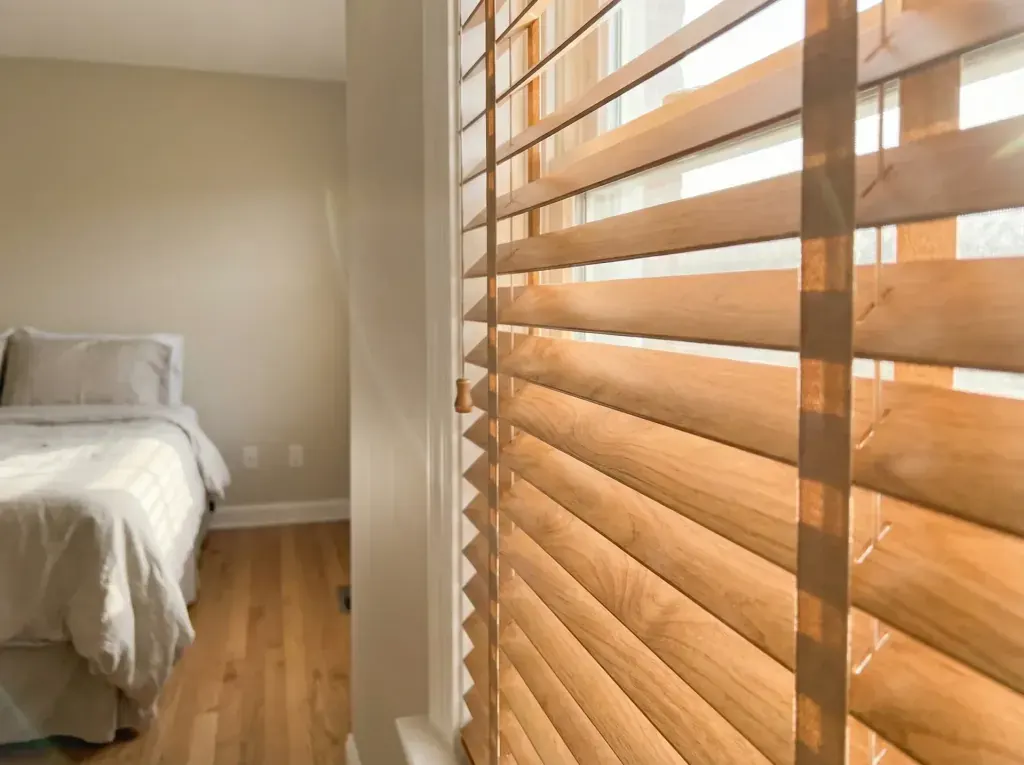
Wood blinds are the most architectural thing you can put on a window. They read as part of the trim rather than as a decoration, which makes the design questions different from picking a fabric. Slat scale, stain, valance style and where the material can survive all matter more than color. A house in Cardinal Estates built decades ago and a new build want different answers. This is a walk through a Whitestown house, room by room, with the calls we'd make in each one.
Real Wood or Faux Wood: How to Choose
Here's the failure mode that explains most of the wood blind complaints we hear. Real wood, almost always basswood, absorbs moisture from the air and releases it again as humidity changes, and that movement warps a slat: cupping across its width, twisting along its length, or both. A cupped slat stops closing flush against the one below it, so the blind that used to shut out light now leaks a thin stripe down the middle, and it only gets worse with the next humid week.
That's specifically a problem over a kitchen sink or in a bathroom, and it shows up in laundry rooms just as often. Faux wood sidesteps it because it doesn't absorb water, but it has its own weak point: a long run of solid PVC slats on a west or south facing Whitestown window can soften and bow after years of direct heat, an issue composite handles noticeably better because of its polymer core.
Measuring, Mounting and Finishing Details
The valance decides how finished a window looks more than any other single choice. A flat valance matching the slats disappears into the window the way it's meant to. A crown valance is shaped and adds a more formal look, better suited to a dining room than a den. On an outside mount specifically, insist on returns, the short end pieces that wrap the headrail back to the wall, since without them you're looking at the bare end of the mechanism from the side.
Underneath the finish, the numbers still have to work. A 2 inch headrail wants roughly two to two and a half inches of flat mounting depth for a flush inside mount, and the Whitestown opening needs checking for square in three places across both width and height, since older homes rarely stay perfectly square over the years. If you're layering drapery over the blind later, mount the rod high and wide enough to clear the headrail and valance depth; measure that projection before the drapery gets made.
Cost, Lift Choices and What Drives the Price
As a national range, stock blinds from a home center run roughly $60 to $600 a window, a sensible buy for a rental or a basement window and nothing to feel bad about. Nationally, custom blinds, measured in the home and installed, run roughly $250 to $2,600 a window, with the range driven by material, from solid PVC through composite to premium stained basswood, along with slat size and whether the slats are route less.
Lift adds its own cost on top of that. Corded is the base price, needing a tensioner fastened to the wall. Cordless and motorized both cost more; cordless carries weight limits on wider blinds, while motorized is usually the single biggest line on a quote, with battery powered motors nationally running roughly $100 to $300 a window less than hardwired versions. Custom orders typically take two to five weeks to fabricate, so there's rarely a reason to rush the decision.
Choose material by room, not by price sheet: faux wood or composite anywhere there's steam or splash, basswood where the room stays dry. Let width and weight decide the lift after that. Whitestown Window Treatments measures every opening and checks it for square before an order goes in. Call (317) 999-5154 for real numbers on your Whitestown windows.
Where Wood Blinds Fit Best Room by Room
If you're weighing wood blinds against other products room by room, here's how they stack up. In a living or dining room, basswood competes well against drapery or a shade, since the slat itself reads as trim and the room's dryness means warping isn't a concern. In a kitchen or bathroom, faux wood or composite is the fair comparison against a vinyl roller or a shade, since all three tolerate splash and steam, though a wood look blind holds its architectural feel in a way a fabric roller doesn't.
Bedrooms are where wood blinds alone lose to a dedicated blackout product, since slats close tight but never fully seal the edges of an inside mount, letting light around the frame regardless of slat size or route less upgrades. Pairing a blind with drapery, or choosing a room darkening shade instead for that one Whitestown window, closes that gap.
Weight, Slat Size and Width Limits
Weight is the line item that quietly changes a quote on a wide window. A large faux wood blind, once it passes roughly five feet wide and runs taller than it is wide, starts pushing against published manufacturer limits, and for good reason: a heavy headrail bows in the middle without a center support bracket while the tilt mechanism stiffens and eventually strips. On top of that, the lift gets hard enough that the blind just stays down.
Basswood weighs about half of what a same sized faux wood slat weighs, so switching material is one way to buy back some margin. Cordless lift is where this bites hardest, because cordless mechanisms rely on springs with published weight limits, and a wide faux wood blind may simply not be offered cordless at all. That pushes the choice toward a corded lift, a motor, or splitting the opening into two blinds on one continuous headrail, all of which change the number on the quote.
Frequently Asked Questions
Do real wood blinds warp in a bathroom?
Often, yes. Wood takes on moisture from the air and gives it back, and that movement shows up as slats that cup across the width or twist along the length. A cupped slat no longer closes flush against its neighbor, so light leaks through in a line and the closed blind looks wavy. In a bathroom with a shower, over a kitchen sink, in a laundry room, or anywhere else moisture collects, use faux wood or composite instead and skip the problem entirely.
Are faux wood blinds always cheaper than real wood?
Usually, but not always. Solid PVC is the cheapest thing in the category. Composite, a wood-polymer core with a painted surface, sits in the middle and can approach the price of basic basswood, while premium stained basswood is the most expensive of all. The better question is which material suits the room, since spending up on real wood for a damp window is how people waste money here, not by choosing the wrong price tier.
Will new blinds match ones I bought two years ago?
Not exactly, and anybody who promises otherwise has not looked at enough wood. Stain absorbs differently depending on the grain of the particular boards a mill runs that week, and painted finishes shift slightly between production runs too. Sunlight then ages the older set. If matching matters, order the whole room at once. If you are adding one window, put the new blind where it is not directly beside the old ones.
 Window Treatments That Actually Hold Up in a Whitestown Bathroom
 DIY Window Measuring: A Straight Answer on the Risk
 Why Whitestown Rooms Feel Cold Even With the Heat Running