Living With Motorized Shades in a Whitestown Home
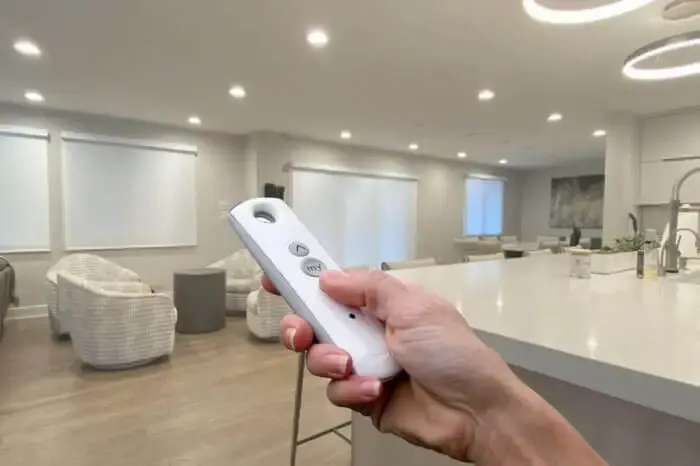
Ask anyone who has lived with motorized shades for a couple of years what actually bothers them. A motor humming at six in the morning. A remote that vanished into a drawer and never came back. This is a blunt look at what goes wrong with motorized shades in a Whitestown home, and what counts as normal wear against what is actually a problem.
How the Motor Gets Its Power
Every motorized shade gets its power one of three ways, and the choice was made long before you started noticing it day to day. A battery wand clips into the headrail and gets pulled out for charging every so often. A hardwired shade runs off wire hidden in the wall, so there is never anything to charge. A plug-in shade sits between the two, drawing power from a nearby outlet through a visible cord.
Living with a battery shade means accepting a small recurring task into the household routine, the way a smoke detector needs a fresh battery eventually. Living with a hardwired shade means never thinking about power again, at the cost of having decided on it before the walls closed. Most Whitestown homes end up mixed: hardwired where it was practical during a remodel, battery everywhere it was added into a finished room.
None of that shows up as a problem on install day. It shows up months later, when one shade is noticeably slower than the rest. Knowing which power method sits behind which shade makes that moment less annoying.
Battery Life and the Charging Routine
Battery life is a cost most people forget to price until they are living with it. Hunter Douglas publishes roughly a year for its PowerView motors, a reasonable planning figure, though a shade running twice a day on a schedule gets there faster than one you only touch on weekends.
The hidden cost shows up in time rather than dollars. Rechargeable wands take hours on a wall outlet, so a shade sits out of service while it charges. On a dozen battery shades with roughly annual batteries, that works out to something coming down for a charge close to once a month somewhere in the house. A solar trickle charger can stretch that interval on a sunny exposure, though it barely helps a shade on a north wall.
Alkaline packs swap in a minute but cost money every time, against a rechargeable wand that costs only attention. The honest way to budget is to assume a small recurring task exists no matter which format gets chosen, and plan the charging schedule instead of waiting for a shade to stop working.
Remotes, Hubs and Schedules
A shade that will not respond to anything is almost never the motor. Check the obvious layer first. Is the remote's battery dead? Is the shade out of range? A router reset or a network change can also drop a hub off its old connection without anyone noticing right away.
Range problems are common enough to be the next suspect. Radio signal does not travel well through masonry or foil backed insulation, so a shade at the far end of a large Whitestown house, or on the other side of a stone fireplace, may simply be too far from the hub. A repeater usually solves this, and it is a cheap fix compared to troubleshooting a shade that was never actually broken.
Travel limits drift, showing up as a shade stopping short of where it should, or overshooting and straining at the bottom. This is not damage. It is a short reset procedure, usually triggered by a hard obstruction during a run or a battery change. Voice control failures are usually a platform issue: a hub that stops answering Amazon Alexa or Google Home after months of working fine more likely reflects an app update than a failed motor.
Which Windows Are Worth Motorizing
Go through the house room by room before ordering and separate the openings that are actually a hassle by hand from the ones merely nice to have automated. That list, more than any showroom display, should drive the budget.
- Anything above roughly eight feet, including transoms and stairwell windows.
- A shade over a tub or a bed, anywhere the cord means climbing up to reach it.
- A room with several shades that should move together as one.
- Large or heavy glass, where a cordless lift discourages daily use.
Cross the rest off on purpose rather than by default. A small bathroom window closed twice a year does not need a motor, and neither does a shade left down permanently for privacy. Pricing this room by room, at roughly $300 to $1,500 a window installed nationally, keeps the budget aimed at openings that will earn it.
Lead time runs two to five weeks once ordered, so build that into any renovation timeline.
Warranty, Service and What Ownership Is Really Like
Two warranties ride along with a motorized shade, rarely the same length. One covers the fabric and mechanism. The other covers the motor and electronics, usually shorter than the first. Ask for both in writing, and ask who comes out when a motor fails in year three, and whether labor is covered or only the part.
That is where buying from a company that measures and installs matters. A motor eventually stops running, and when the installer holds the account with the manufacturer, a claim goes through them and someone shows up. Buy the same shade online and the relationship is yours to manage, along with the shipping and the reinstall.
Day to day quirks are mostly minor: a brief motor hum while traveling, noticeable in a quiet bedroom at six in the morning. Two shades on one group can drift out of alignment after a year, which is a limit reset, not a defect. A Whitestown summer schedule is not a January one, so treat the system as a seasonal habit, swapping scenes and checking batteries when the clocks change.
Most motorized shade complaints trace back to a battery that needs charging or a limit that drifted out of place, not to a broken motor. A hub that lost its network is the other common culprit. Knowing which is which saves a service call more often than not. Whitestown Window Treatments is insured and bonded and stands behind the systems installed in Whitestown homes. Call (317) 999-5154 if something is not behaving.
Frequently Asked Questions
What are travel limits and why do they matter?
They are the upper and lower stopping points programmed into each motor at install. They are what makes several shades on one wall stop at exactly the same height instead of an uneven row. Limits can shift after a battery change or if a shade hits an obstruction on the way down. Resetting them is usually a short procedure you can do yourself, so ask the installer to demonstrate it and to write down which channel runs which shade.
Which windows are actually worth motorizing?
Anything above roughly eight feet, where hand operation means a pole or a ladder. Shades behind a sink, a tub or a bed. A room with several shades that should move together, since one button replaces several trips nobody actually makes. Large or heavy glass, where a cordless lift is a workout. Any opening where reach or mobility makes a manual shade a genuine barrier. A small bathroom window touched twice a year is not on that list.
Is hardwired better than battery?
It is better in specific situations rather than in general. Hardwired never needs charging, which makes it the right call for high openings and for houses with a lot of shades. It costs more, since battery motors run roughly $100 to $300 a window less nationally, and retrofitting wire into a finished second floor is slow going. In a finished house with a handful of shades, battery is usually the sensible default.
 Window Treatments That Actually Hold Up in a Whitestown Bathroom
 DIY Window Measuring: A Straight Answer on the Risk
 Why Whitestown Rooms Feel Cold Even With the Heat Running